
Loyalty system · Automation
A loyalty system for a beauty salon
A salon with nine stylists, a full client base and bookings kept in Altegio. Revenue rested on new clients, although the base was already large enough to bring in good profit on its own. We did not raise the acquisition budget — we brought back the people who had already been there.
Point A — what they came with
The situation at the start
The request sounded like one task — “we need a loyalty programme”. After going through the base it turned out there were two tasks, and different tools close them.
The client left the salon saying “I’ll call when I need to” — and never called. The reason was not the quality of the service: nobody was creating the moment of the next booking.
- Most clients came exactly once and never returned
- Rebooking at the desk was not a procedure — it happened depending on mood
- There was no segmentation at all: everyone got the same messages
- Reactivation was tied to the calendar rather than to a specific service’s cycle
- Stylists saw upselling as not their job, and receptionists were afraid to push
- Home care sat on the shelf and almost never made it onto the bill
Diagnosis
This is not one problem but two
They look alike, which is why people keep trying to close both with one tool — a discount. A discount closes neither.
The leak at the entrance has to be closed first. While more than half the base never reaches a second visit, there is simply nobody to upsell to — which is why the work runs in this order and not the other way round.
They do not return
What happens
After the visit there is no next date set. The client leaves saying “I’ll book later”.
What actually works
Rebooking in the chair and at the desk, plus reminders on the specific service’s cycle.
They do not upsell
What happens
The stylist and the receptionist have no clear role, script, incentive or moment of sale.
What actually works
A system of three points of sale, an upsell matrix and team KPIs.
A loyalty programme keeps money inside the base. On its own it does not sell.
Where the money leaks out
Rebooking at the desk
Retail share of revenue
1st visit to 2nd conversion
- Now (typical)
- Achievable
50–70 %
of clients come exactly once
That is a bigger hole than any unsold home care. The leak at the entrance has to be closed first — otherwise there is nobody to upsell to.
Scope of work
What the system includes
The system is assembled in two documents: a concept with the rollout specification and a 28-slide deck for the salon team. Below is the structure; the parameters, tables and scripts stay with the client.
- Initial audit of the base in Altegio
- Segmenting the base by client behaviour
- Service cycles as the basis for automation
- Rebooking as a mandatory procedure
- Three points of sale: booking, chair, front desk
- An upsell matrix built on the actual services
- Loyalty mechanics: a bonus instead of a discount
- Client tiers and thresholds by annual spend
- Packages, subscriptions, deposits, referrals
- A map of automated scenarios and triggers
- Message templates for every scenario
- Reason codes for client churn
- Incentives for stylists and receptionists
- A monthly campaign calendar
- Stock Altegio versus custom development
- The legal basis for communication
- Control KPIs and measurement points
- A 90-day rollout plan
- Launch risks and how we remove them
- The owner’s dashboard and the next steps
Along with the documents the salon got scripts for receptionists and stylists, message templates for every scenario and a training plan for the team.
The plan
The system rolls out in four layers, and each one rests on the previous.
-
1
Diagnosis
Where exactly the base loses money and which figures show it.
-
2
Retention
Rebooking, triggers, segments, loyalty mechanics.
-
3
Upselling
Three points of sale, a service matrix, team incentives.
-
4
Automation
What Altegio does out of the box and what is worth building on top.
Want the same system for your own salon?
We will pull the figures from your CRM, calculate the real service cycles and build a system that brings the base back
The main lever
The strongest tool costs nothing
The difference between two sentences from the receptionist changes rebooking several times over. The first leaves the client alone with a decision for “sometime later”. The second asks a closed question with two options and ties it to the specific service’s cycle.
This is a procedure, not automation: it takes a day to introduce and needs neither development nor budget. That is why it comes first in the plan, and the bot only in phase three.
The usual way
“Shall I book you in?”
“Thanks, I’ll call”
10–20 % rebooking
The way it should be
“Your colour will need refreshing in about 4 weeks — that’s early October. Is Thursday evening or Saturday morning easier for you?”
The client picks one of two options
50–60 % rebooking
Rebooking went into the visit-closing checklist and became a KPI for the receptionist — otherwise it rests on one person’s memory and on whether they had time that day.
Retention
A bonus instead of a permanent discount
A discount also goes to people who would have come anyway. It is always on, so it creates no reason to come right now, and taking it away without a conflict is no longer possible.
A bonus works differently: it has an expiry date and sits “in the salon account”. Not using it is a loss, and loss moves people more strongly than gain. Tier thresholds are counted by spend over twelve months, not by the number of visits.
The key rule
A client’s segment is set by the specific service’s cycle, not by the calendar
A manicure client goes dormant after five weeks, a haircut client after ten. A shared “60 days for everyone” threshold means part of the base is contacted too early, and part when they have already settled into another salon.
Parameter
Starting mechanics
Why
Accrual
5 % of the bill
Base cashback.
Validity
90 days
Returns the client to the cycle.
Redemption cap
up to 30 % of the bill
Protects the margin.
On retail
yes, 5 %
Encourages home care.
On promotional services
no
Do not stack a discount with a bonus.
Warning
14 days before expiry
Creates a strong trigger to return.
Starting parameters. The final cashback rate and redemption cap are checked against the margin of the salon’s specific services.
Upselling
Three points of sale, and the one that converts best is not the front desk
Two offers per visit at most. The stylist’s rule: first state the fact, then the pricier and the more affordable option. Not “buy this”, but “here is what I see”.
At booking
We extend the coming visit before the client even arrives — and immediately block more time for it in the stylist’s schedule.
In the chair
The strongest point. The stylist diagnoses out loud and offers two ways forward: the pricier one in the salon and the more affordable one at home.
At the front desk
Home care, a subscription, the bonus balance and rebooking. Declining the pricier option does not end the conversation — there is a written downsell for it.
The stylist’s formula · diagnosis → two options
“I can see the ends are splitting. We can do a treatment today — that’s another twenty minutes, or I’ll pick out a product for home: cheaper, but the result will build up more slowly.”
A downsell is not a lost sale. Declining the pricier option only means a different format of solution is needed.
If the client says no
Every refusal has an alternative written out in advance — so the conversation does not end on the word “no”.
The client declined
We offer instead
A full salon treatment
An express version or a product for home.
Complex colouring
Toning or a root touch-up.
A course of treatments
A single treatment, back to the subscription later.
An expensive product
A mini format or a sample.
A slot this week
A specific date next month.
The rollout plan
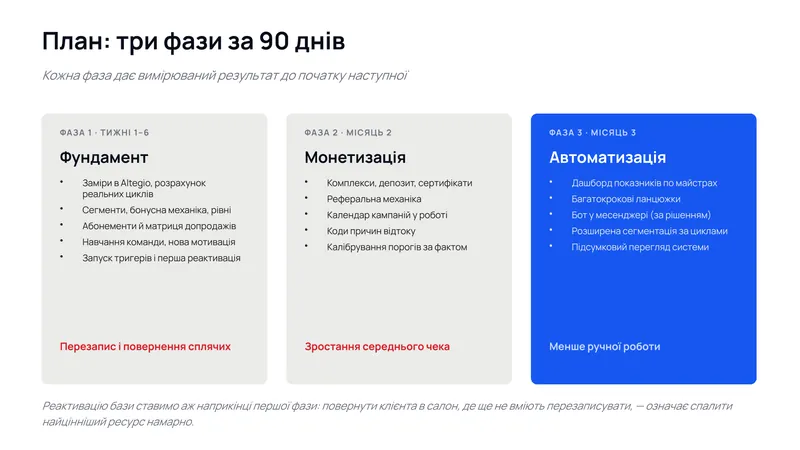
Three phases in 90 days
Every phase delivers a measurable result before the next one starts. Reactivating the base comes only at the end of phase one: bringing a client back to a salon that has not yet learned to rebook them means burning the most valuable resource for nothing.
-
Phase 1 · weeks 1–6 — Foundation
We take the baseline figures, calculate the real service cycles and build the frame of the system.
- Measurements in Altegio and calibrating the thresholds
- Segments, bonus mechanics, client tiers
- Subscriptions and the upsell matrix
- Training the team and the new incentive scheme
- Launching the triggers and the first reactivation wave
-
Phase 2 · month 2 — Monetisation
The system already brings people back — now we raise the value of each visit.
- Bundles, deposits, gift certificates
- Referral mechanics
- The campaign calendar in use
- Churn reason codes in the client record
- Recalibrating the thresholds against actual data
-
Phase 3 · month 3 — Automation
We automate what has already settled into a process rather than chaos.
- A dashboard of figures per stylist
- Multi-step chains with branching
- Extended segmentation by service cycles
- A messenger bot — at the client’s discretion
- A final review of the whole system
Control measurements
How we know the system works
The measurements sit in the plan as three checkpoints, not at the end. On day thirty you can see rebooking and home care — the fastest indicators. By day sixty the depth of the bill and the return of dormant clients catch up. By day ninety you see what it was all for: first-to-second visit conversion and the average bill.
The main metric over distance is the share of revenue from returning clients. It shows whether the salon is really building retention or simply selling better to new people. Every intermediate figure is subordinate to it.
30 days
Rebooking at the desk
15 % → 40 %+
Retail share
2–3 times
60 days
Depth of the bill
+0.2–0.3 services
Dormant clients returned
15–25 % of the segment
90 days
1st visit to 2nd conversion
+10–15 pp
Average bill
+15–25 %
Every phase delivers a measurable result before the next one starts. If a figure will not move, we first work out why, and only then go on.
Point B — the results
Point B
+0 %
to the average bill in 90 days
0
of extra budget on acquiring new clients
0
sections of the system with a rollout specification
0
services with a calculated client return cycle
0
automated triggers in the scenario map
0
segments of the base instead of one mailing for everyone
AfterWhat the salon got
- A system concept with a rollout specification
- A 28-slide deck for training the team
- Segmentation by behaviour instead of one mailing for everyone
- Calculated service cycles as the basis for every reminder
- Rebooking as a mandatory visit-closing procedure
- Bonus mechanics with tiers instead of a permanent discount
- An upsell matrix built on the salon’s actual service list
- An incentive scheme for stylists and receptionists
Niche: beauty industry · Format: consulting and rollout
A repeat-sales system — instead of discounts to acquire new clients
Conclusions
What this project gave
Instead of a loyalty programme “for the sake of having one”, the salon got a system where it is clear who is being brought back, exactly when, and what is offered.
First we closed the leak at the entrance and made rebooking part of the standard, and only then connected the bonus mechanics, the packages and the automation.
The money was inside the base
The acquisition budget was not increased. The growth came from working with people who were already in the base and simply had not been given a reason to return.
The system does not depend on an employee’s mood
Rebooking in the visit-closing checklist, a script for the stylist, incentives for behaviour rather than a one-off bill. The result stops depending on whether the receptionist had time that day.
We connect automation when there is something to automate
The first two phases run on stock Altegio functionality. The bot and the dashboards sit in phase three — otherwise you automate chaos.
Get in touch